In the 1980s, a popular poster hung on the walls of schools, guidance offices, and university recruitment centers.
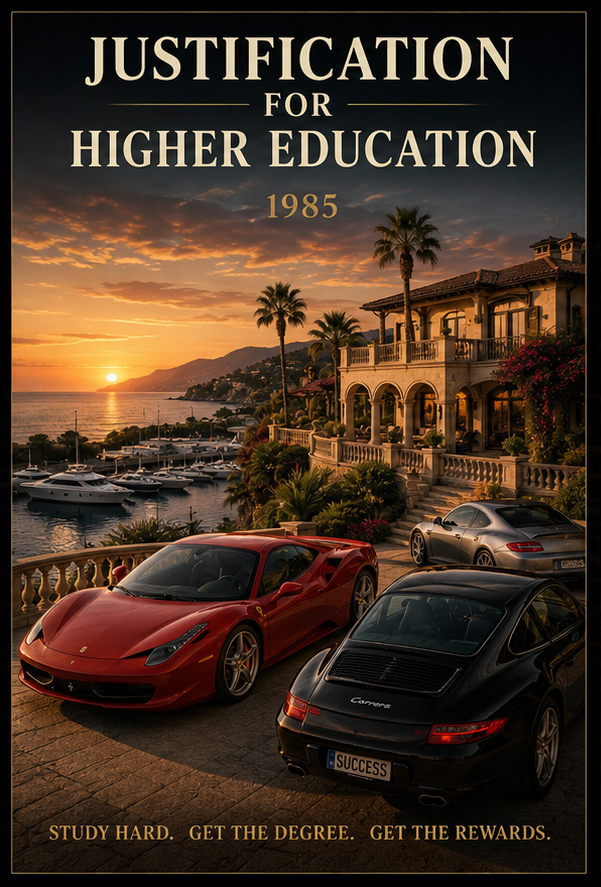
Across the top were the words:
JUSTIFICATION FOR HIGHER EDUCATION
Beneath them sat a cliff-top villa overlooking the ocean. A row of sports cars rested in immaculate garages. Palm trees framed a perfect sunset.
The message required no explanation.
Study hard.
Get the degree.
Get the rewards.
At roughly the same time, Derek Bok, President of Harvard University, offered a remark that became famous:
“If you think education is expensive, try ignorance.”
For decades, these two ideas reinforced each other.
Education was presented not merely as valuable, but as the primary route to prosperity, security, and social advancement. Parents repeated it. Teachers repeated it. Politicians repeated it. Universities built an industry around it.
The story was simple.
Go to university.
Work hard.
Earn your credentials.
The system will reward you.
The problem is not that the story was completely false.
The most powerful foma are never completely false.
For much of the post-war period, the bargain largely worked. University graduates generally earned more than non-graduates. Housing was affordable. Career ladders existed. Organizations invested in employees and promoted them from within. A degree often translated into opportunity.
But somewhere along the way, something subtle happened.
Education and credentials stopped being the same thing.
Universities continued to speak the language of education while increasingly selling credentials.
Those are not identical products.
Education is the development of judgment, curiosity, understanding, and the ability to think.
A credential is an institutional token certifying that you successfully passed through a system.
For a long time there was substantial overlap between the two.
Today the gap is becoming impossible to ignore.
Young people are accumulating unprecedented levels of debt in pursuit of credentials. They are entering housing markets that have detached from wages. They are competing for positions that increasingly require credentials merely to enter the queue. And just as many reach the workforce, artificial intelligence arrives to challenge the economic value of large categories of knowledge work.
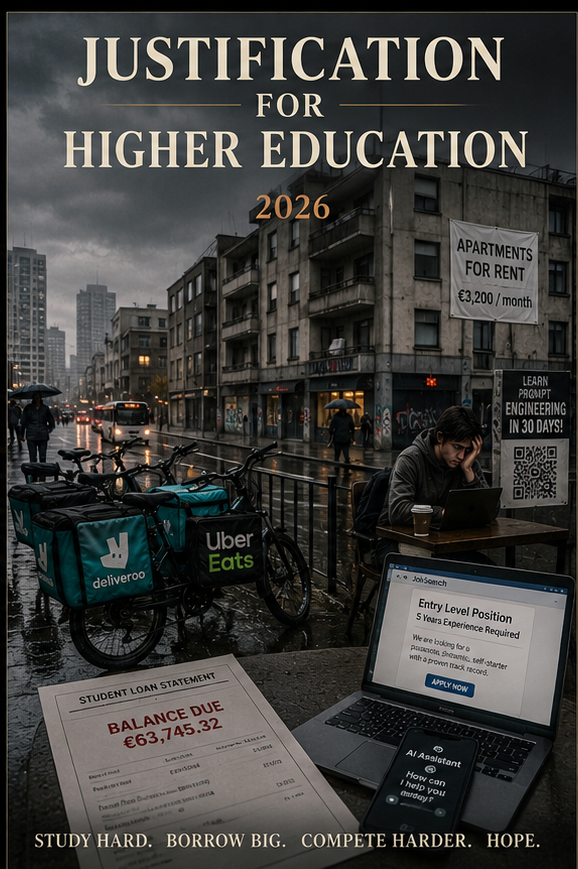
The old promise was:
Education → Career → Prosperity
The emerging reality often feels closer to:
Credential → Debt → Competition → Uncertainty
This is not primarily a failure of students.
Nor is it entirely a failure of universities.
It is a failure of a story.
The story assumed that credentials and education would remain tightly coupled forever.
The story assumed that institutions would retain a near-monopoly on knowledge.
The story assumed that the future would look broadly like the past.
Artificial intelligence challenges all three assumptions.
For centuries, universities controlled access to knowledge. If you wanted expertise, you had to pass through the gatekeepers.
Today a curious teenager with a laptop can access explanations, tutoring, simulations, historical archives, programming assistance, language instruction, and technical guidance at a scale unimaginable even twenty years ago.
Knowledge is becoming abundant.
Which raises an uncomfortable question:
If knowledge is becoming abundant, what exactly are universities selling?
The answer is not nothing.
Universities still provide community, mentorship, research, networks, legitimacy, and social connections.
But increasingly they are also selling access to a credentialing system.
And that distinction matters.
Because when institutions market credentials as education, disappointment becomes inevitable.
The student believes they are purchasing a future.
The institution often believes it is providing an opportunity.
The difference between those two beliefs is where much of the frustration of younger generations now resides.
None of this means ignorance has become desirable.
Derek Bok was right about one thing.
Ignorance remains expensive.
But perhaps the more relevant question in 2026 is this:
What if the expensive thing was never education?
What if the expensive thing was believing that credentials and education were the same thing?
The old poster promised a villa, sports cars, and a sunset.
The real value of education was never any of those things.
Its value was the ability to navigate a changing world without becoming trapped by yesterday’s assumptions.
Ironically, that may be the one lesson the poster failed to teach.